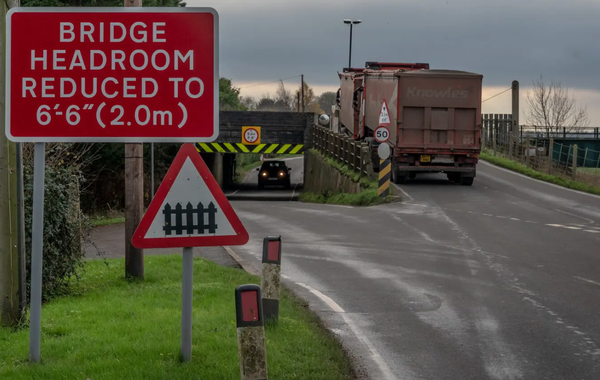
Bridge Headroom
Reduced to 6'-6" does not accurately convey the urgency of the present circumstances!
How about: "No SUVs, trucks,
campers, and vans to the left ahead"
In fact, there are a LOT of ways to make this warning better, and thus create
a massively improved customer experience.
What's your idea?
Reply to this email with your best idea for a Stonea rail bridge warning sign. Best answer will win a $20 Amazon gift
card.
Why is this important?
Because too often when customers have problems - especially recurring ones - we blame THEM for not being able to figure it out.
At one time, I led customer experience for a software startup that offered free video calling over the Internet. It was essentially Skype long before Skype existed.
I pointed out to our lead developer that one of the buttons customers needed to click to connect a call was not intuitive, and was creating a lot of confusion.
"If people aren't smart enough to figure this out, we don't want them as customers." He actually said that. Those exact words!
It is not the customers' job to gaze through your haze and figure out how your product or service works.
It is YOUR job to either make the product or service so seamlessly usable that questions are largely unneeded, or to at least communicate with enough precision and clarity that you don't get 33 cars running
into a train bridge annually.
So as we get rolling on 2023, here's some advice:
1. Figure out the 10 questions your customers ask most often.
2. Set a goal of reducing frequency by 50% (this year, only 16 train bridge disasters!)
3. For each of the 10, honestly determine WHY they have to keep asking.
4. By the end of January, concoct and enact a plan to communicate with the precision and clarity necessary to reduce questions volume.
Confusion is never a natural state.
It's just a byproduct of weak communication among the responsible party. And in almost every case, the responsible party is the company or organization, not the customer or patron (or driver).