this was not my experience
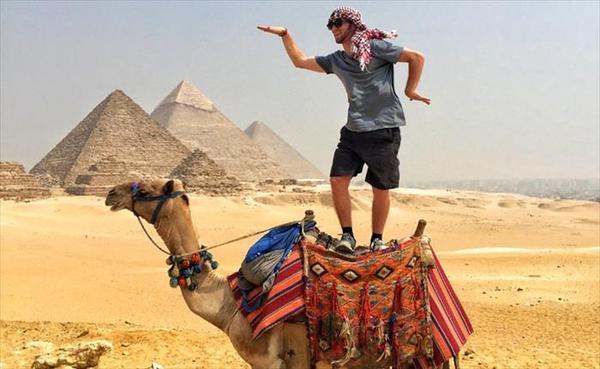
To say my camel was not on his A Game is an affront to the alphabet. He was quite ill with some sort of dromedary intestinal virus, and correspondingly ill-tempered.
As the pack loped along we fell further and further behind, due to general lethargy, and an alarming tendency for my camel to veer suddenly into the trailside palm groves to relieve himself.
In an attempt to keep us in sight of the group, a rearguard consisting of a solitary boy, perhaps 10 years
old, riding bareback on a donkey, would every 30 seconds whack my camel on the behind with a branch, urging forward momentum.
This was not effective, other than to cause my camel's pace to shift from stuporous to sprinting, in between palm-side restroom breaks.
It was not an ideal afternoon.
Mathematically, my experience with camels was uncommon.
In our very own group, 97.5% had a 5-star experience. 2.5% had a 1-star experience. And a check of reviews indicates that the overwhelming majority of camel riders are enchanted, to this day.
And this is the problem I frequently encounter when working with companies on customer experience initiatives: confusing anecdotes for data.
The truth is that almost always, the camel ride is awesome. Rarely, it is not. (And never has the phrase "shit happens" been more apt.)
But inside organizations, the exception is more memorable than the usual. This is the stuff of internal legend, verbally passed from
employee to employee like ancient mythology.
"Remember that one time, when (customer) did this, and (company) did that?"
These anecdotes are given too much illustrative power due to two brain science truths: we are wired to remember the atypical and ignore the typical; and we are wired to remember stories more so than numbers.
And thus, when the company seeks to alter or optimize customer experience in some fashion, these stories are often used (in the words of the Scottish poet Andrew Lang), "as a drunken man uses a lamp posts - for support rather than illumination."
Based only on my tale, it would be easy to conclude that all camels should be pre-ridden before distribution to unsuspecting tourists - or some such attempt to mitigate.
But realistically, my experience was a rare "edge case," and thus to upend the operations to try to control for that
scenario might end up doing more harm than good, on the whole.
I love stories. I make a
living telling them. Stories have power.
But don't let that power cause you and your
colleagues to draw conclusions based solely on narrative-rich exceptions, and subsequent assumptions.
As my pal Tom Webster says: the plural of anecdote is not data.
As we enter the AI era of customer experience, it will be more important than ever to make our strategic and operational decisions based on math, not just a good story.
As they say in the camel biz, it's time to get over the hump.